
Work strategically
I choose and use my career for maximum gospel impact
Read all three pathway articles
This article is only half the picture. Each strategic pathway has its own article with stories, example roles, spiritual dangers and resources. We’d love you to read all three as you think about your career.
In this article we’ll explore what impact is, why it’s important and some principles of impactful careers.
Then we’ll consider how we should discern our career choices and share three pathways that can be particularly strategic for some individuals.
Understanding impact
Impact is the effect of what we do. It is the change our actions make in this world, some of which can last into eternity. God gives us work to do, and we should work hard to make a lasting impact.
It’s about disciple-making impact
“Go and make disciples of all nations.”
We should all be seeking to make the most of our disciple-making impact. Why? Because making disciples is the main mission Jesus has given us. This mission was both the first and last thing he said to his disciples. Jesus’ last words before ascending to Heaven were the call to make disciples. Less familiar are Jesus’ first words, though they point to exactly the same purpose: “Come, follow me,” Jesus said, “and I will send you out to fish for people” (Matthew 4:19“Come, follow me,” Jesus said, “and I will send you out to fish for people.”Matthew 4:19 (NIV)). The people Jesus speaks about here had their lives changed forever by becoming his followers.
But what does it mean to make disciples? A disciple is more than someone who just believes in Jesus. It also includes commitment, joyful obedience and action. As Jesus explains, making disciples includes “teaching them to obey everything I have commanded you” (Matthew 28:20and teaching them to obey everything I have commanded you. And surely I am with you always, to the very end of the age.Matthew 28:20 (NIV)).
Being a disciple is not simply about identifying as a Christian or attending church once a week. It is about abiding in Jesus, enjoying fellowship with him. From this flows a reordering of our loves and priorities around Jesus’ teachings, learning to obey all that he commanded. Such transformation, in us and others, will inevitably shape the way we live, influence those around us, and change the world.
When we look at our world, we can see so many desperate needs: poverty to overcome, jobs to create, wars to end, creation to care for and diseases to cure. Christians can and do obediently respond to these needs in many ways. Yet we believe that every human being’s deepest need is to know Jesus and to follow him. In God’s common grace, non-believers and believers alike share in the task of addressing one another’s needs as neighbours. But sharing the good news about Jesus is something that only those of us who know Jesus already can do. For this reason, we see disciple-making as of particular importance.
In light of this, it is also important to remember that practical service, carried out in Christ’s name and through the Church, is central to being faithful disciples ourselves, and can also be a powerful way of making disciples of others.

The power of the gospel
“Five years ago I hit rock bottom. I’d just finished university and my parents got divorced. I was drinking, taking drugs and was hopelessly lost in my faith. Then, on my way home from my Ryanair cabin crew job, my car brakes failed. I crashed into the back of the car ahead, and my insurance company wouldn’t pay up. I was £14k in debt and almost became homeless.
Desperate, I reached out to Christians Against Poverty (CAP), and two amazing accountants came weekly to help and pray for me, changing my life by showing me Jesus in a time I was breaking. It made me hunger for God and go back to church.
Now I have a reason to live. My life is going up and up. I’ve become a youth pastor, growing our brand new group to twenty kids. Last year, I started a Christian YouTube channel about men’s mental health, which has grown to almost 10k subscribers in a year. I love football, so I launched a Bridge the Gap football group, and I have now seen a hundred men come through. Last week at church, I looked around and saw five of the welcome team had all come to faith through this football ministry.
It started with two accountants willing to go all-in, to speak Jesus to a broken man. Now my life is transformed, and I get to help others to also find Jesus.”
How does work fit into this mission?
Work is good in and of itself
God is a worker – and we’re made in his image to work (Genesis 2:15The Lord God took the man and put him in the Garden of Eden to work it and take care of it.Genesis 2:15 (NIV)). Work is good. Work came before the fall, and it will continue into the new creation (Isaiah 65:21).
Yet work is harder because of the fall
Because of the fall, even the best jobs will be frustrating and feel broken (Genesis 3:17–19).
All work (paid or unpaid) serves Jesus
Now work of any kind is a key way we partner with Christ in serving his world, even as we await its full renewal.
“Whatever you do, work at it with all your heart, as working for the Lord, not for human masters, since you know that you will receive an inheritance from the Lord as a reward. It is the Lord Christ you are serving.”
All work has a huge opportunity for disciple-making
Careers are 80,000 hours long; they’re one of the most significant resources God has given us.
In God’s kingdom, no job makes you more important. We are all different parts of one body. The eye cannot say to the hand, ‘I don’t need you!’ (1 Corinthians 12:21).
Yet whilst all work can honour God and create opportunities for witness, some careers can offer far greater disciple-making impact than others for the same individual.
So if we’ve got the privilege of being able to choose our career, we should steward it wisely for his mission of making disciples.
Impact matters
Fruitful is faithful
Jesus commands us as his disciples to surrender everything we have to him (Luke 14:33In the same way, those of you who do not give up everything you have cannot be my disciples.Luke 14:33 (NIV)). We are called to depend on him and to use what he has given us for a huge kingdom impact, especially if we’re gifted with greater skills, resources, or intelligence.
Jesus teaches us to seek a return. In the parable of the talents (Matthew 25:14–30), the master commends the servants who doubled the money he had entrusted to them, saying to each, “Well done, good and faithful servant”. Jesus values fruitful stewardship and meaningful results.
He expects extraordinary returns. The parable of the sower shows that as the good soil, we will yield a hundred, sixty, or thirty times what was sown (Matthew 13:23).
“But the seed falling on good soil refers to someone who hears the word and understands it. This is the one who produces a crop, yielding a hundred, sixty or thirty times what was sown.”
Those who’ve been entrusted with more talents have a particular responsibility to surrender and multiply it for a high impact. Living in the west, we’re blessed with access to many more opportunities and resources than many of our global neighbours. We’re called to steward this wisely.
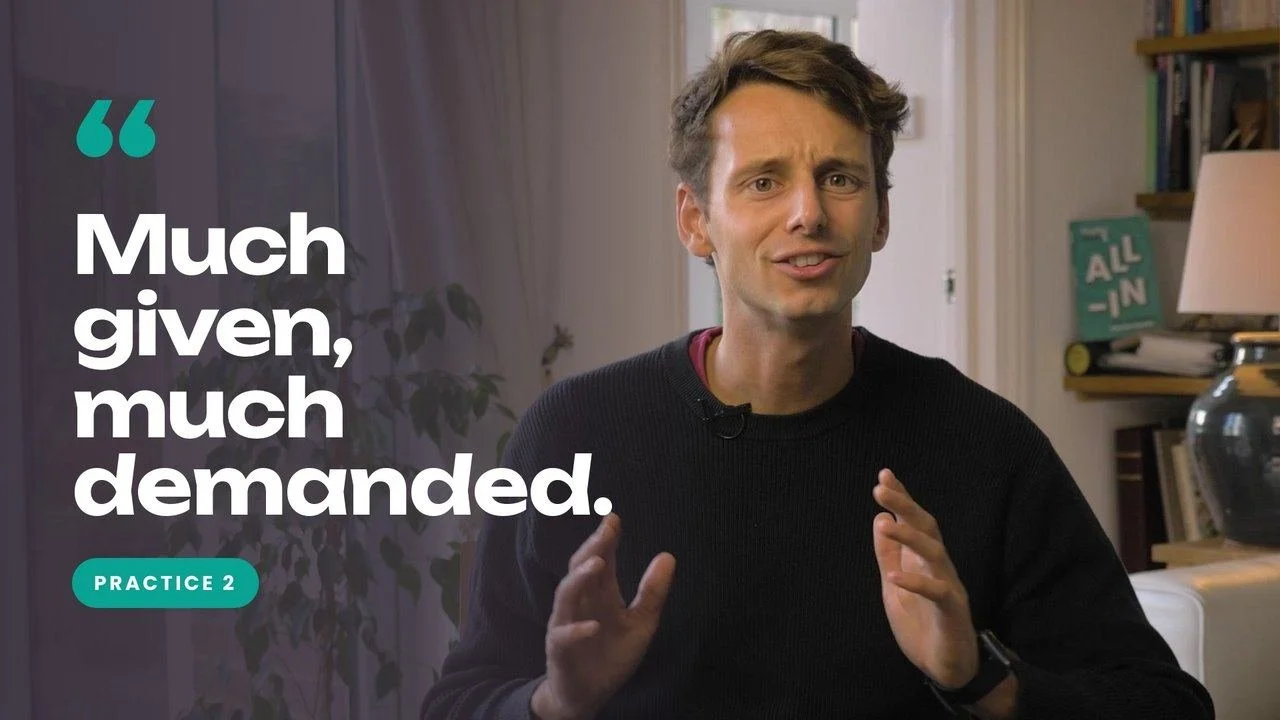
“From everyone who has been given much, much will be demanded”
God is glorified as we bear fruit.
“This is to my Father’s glory, that you bear much fruit”
The stakes are high
Following Jesus is so significant because he brings life in all its fullness in the here and now and life everlasting.
Jesus’ heart aches for those who are far from him. He sees the great need in the world and calls us to action, “The harvest is plentiful, but the workers are few” (Matthew 9:37Then he said to his disciples, “The harvest is plentiful but the workers are few.”Matthew 9:37 (NIV)). The call is urgent.
We are the workers in the harvest field called to participate in God’s mission of making disciples and seeing lives transformed for his Glory. Focusing on impact and effectiveness is crucial because the stakes are so high. To reach as many as possible with the gospel, we must give ourselves fully to the work of the Lord (1 Corinthians 15:58Therefore, my dear brothers and sisters, stand firm. Let nothing move you. Always give yourselves fully to the work of the Lord, because you know that your labour in the Lord is not in vain.1 Corinthians 15:58 (NIV)).
All-in with our intelligence
We may be familiar with the call to go all-in with our time and money. We’re perhaps less familiar with the call to go all-in with our intelligence as well. This means working smart as well as hard. God wants us to wisely steward our intelligence for him just as we do our time and money.
If we rely solely on our hearts without engaging our minds, we risk missing significant opportunities for impact. Focusing on effectiveness counteracts this by applying Spirit-given wisdom and intelligence to use every gift and resource in ways that bear the greatest fruit for God’s kingdom.
Jesus calls us to be shrewd (astute) in how we use our wealth and gifts. In the parable of the shrewd manager, Jesus chastises the “people of the light” for being naive in their understanding of how to use their worldly wealth (Luke 16:8). Being effective requires us to be shrewd in using what God has given us.
Effectiveness involves aiming for tangible outcomes. For example, Paul’s ministry is goal-oriented; he strategically adapts to be the most humble servant in any context to “win as many as possible” for Christ (1 Corinthians 9:19–23).
Yet we surrender the outcomes to God
Whilst we plant and water, it is God who makes things grow (1 Corinthians 3:7So neither the one who plants nor the one who waters is anything, but only God, who makes things grow.1 Corinthians 3:7 (NIV)). Like Jeremiah, we may labour faithfully for the kingdom with little visible impact, but God’s plans extend far beyond our perspective. Acting with godly integrity can sometimes look foolish or counterproductive – but we remember that “the foolishness of God is wiser than human wisdom, and the weakness of God is stronger than human strength” (1 Corinthians 1:25).
We should try for the biggest impact, but surrender the eventual impact to God.
Principles of impactful work
Your greatest impact won’t necessarily come from a paid job. Whether across your whole career, or just in specific seasons, you might have greater impact through other forms of work, like raising children, volunteering, caring for relatives etc.
Regardless of the work you’re engaged in, here are some helpful principles to consider:
1. Consider the gap factor
The gap factor – sometimes called “counterfactual impact” – is the difference you make by doing something versus what would have happened if you hadn’t done it. If other people would fill the gap anyway, then the impact isn’t as big as somewhere you can make a unique difference.
What would happen without you?
Your church might have more guitarists than slots in the worship band, so joining doesn’t have much “gap factor” as worship can happen without you. Instead, joining the youth team, where leaders might be desperately needed, could enable deeper discipleship for teenagers – work out what the gaps are in your context.
How to use this
Apply this lens to your career, volunteering and giving. Increase your impact by focusing on neglected issues where, if you were not involved, the work might never happen or would happen at a much smaller scale.
This is humbling
Thinking about gaps and counterfactuals reminds us that the impact we personally achieve is not what ultimately matters. What matters most is that God’s kingdom grows, whether through us or through others.
2. Multipliers
Multipliers are things that can double, triple or 10x your impact. Consider both the number of people you’ll impact and the degree to which you’re impacting them. Here are some examples:
Influence others to be impactful
You can do this by “sticking your head above the parapet” or by actively raising up other leaders.
Multiply your impact by choosing roles where your influence can empower others to have a high disciple-making impact. For example, doing academic research into the effectiveness of Christian charities may encourage others to do likewise, informing donors to give more effectively.
Or we could go “out a level”, expanding our gospel influence by becoming more senior, such as moving from a teacher to a headmaster. Another way is by shifting to roles which have a more system-wide influence, such as shaping the education curriculum.
Pioneering work
Being the “first mover” in an area enables future impact. For example, being a missionary to North Africa may seem to make few disciples, but these disciples may start a movement of faith. For example, David Livingstone made few disciples himself, but he paved the way for the gospel across sub-Saharan Africa. The success of the Alpha course sparked many more courses – Christianity Explored, the Marriage Course and even more recent courses like Practicing the Way or the Prayer Course.
Shaping people earlier
76% of people become Christians before turning 18 years old1Note 1Talking Jesus Report (2022), available online at www.talkingjesus.org/research, so engaging with people during formative stages of life can be especially impactful, such as ministering to youth, kids, students and parents.
Giving our money more effectively
See Give effectively for more.
3. Career capital
Focus on building up your career capital. This includes your character, skills, experience, credentials and network that allow you to have higher career impact in future.
Developing your character is the most important area for long-term impact.
Also helpful is flexible capital: things useful across sectors and that are resilient to advances in AI and automation (e.g. communication, leadership, tech, strategy and empathy).
Cal Newport’s So Good They Can’t Ignore You is a helpful secular book on career capital. He explores how to develop rare and valuable skills, and how to find a unifying mission to put them to impactful use.
Impact starts small
It’s important to remember our impact at the start may be small. God often leads us through wilderness years where we feel we have little outward impact, but inwardly the gospel is transforming us. Luke 16:10 tells us “Whoever can be trusted with very little can also be trusted with much”.
It is easy to overestimate what can be achieved in five years. It is easy to underestimate what the Lord can achieve through us in twenty years.
It can be helpful to consider our careers in three stages:
- 1
Explore
Approx 18 to 25 years oldWe try out different areas and consider how we might best serve God. We consider which direction will help us make the biggest kingdom impact.
- 2
Build Career Capital
Approx 25 to 35 yearsWe step out in faith and commit to an area. While we seek to have impact now, these years can feel like the wilderness with little visible impact. But it’s here we develop our career capital.
- 3
Deploy
Approx 35+We use the talents we’ve developed to best build God’s kingdom. We steward all that we have built in experience, relationships and opportunities in a focused way for long-lasting impact.
You might also go through these stages again in a quicker way if you go through a career change.
Choosing your career
Surrender to the Spirit
For many, after choosing to follow Christ and deciding whether and who to marry, our choice of career is the most important decision we’ll make. So we must dedicate ourselves to prayer.
Stop reading right now and pray!
Without abiding in Christ through prayer, we cannot bear any fruit through our career (John 15:5). But if we “in all our ways submit to him”, he will make our “paths straight” (Proverbs 3:6in all your ways submit to him, and he will make your paths straight.Proverbs 3:6 (NIV)).
We particularly love the Wesleyan Covenant Prayer, which is printed below. It offers us powerful words of surrender to the service and glory of God. Why not pray through it slowly now, and then pray for wisdom and guidance in your decision-making?
I am no longer my own, but yours.
Put me to what you will,
place me with whom you will.
Put me to doing, put me to suffering.
Let me be put to work for you
or set aside for you,
Praised for you or criticised for you.
Let me be full, let me be empty.
Let me have all things,
let me have nothing.
I freely and fully surrender all things
To your glory and service.
And now, O wonderful and holy God,
Creator, Redeemer, and Sustainer,
You are mine, and I am yours.
Amen
How God guides us
As we dedicate ourselves to the Spirit’s guidance, it helps to understand the different ways God guides us. In his book Questions of Life, Nicky Gumbel memorably sums up the main ways God leads us as “the 5 CSs”:
- Commanding Scripture (God’s word through the Bible)
- Compelling Spirit (the Spirit’s prompting)
- Counsel of the Saints (advice from Christians)
- Common Sense (God-given reason)
- Circumstantial Signs (“God-incidences”)
Myth: God’s leading will be unmistakable
If we mistakenly think that God’s leading must be a sudden, spectacular event, few of us would ever consider ourselves led to a particular career. In Scripture, very few people received direct, unmistakable guidance into a role. God promises to give wisdom to those who ask (James 1:5If any of you lacks wisdom, you should ask God, who gives generously to all without finding fault, and it will be given to you.James 1:5 (NIV)), but wisdom is something we need to exercise, rather than being told exactly what to do.
We don’t need to live in fear that we might miss God’s “Plan A” for our lives. There’s no one career we’re “called” to. If we approach our career decisions prayerfully and wisely, we can move forward with confidence that God is guiding us and working through our choices.
We shouldn’t lean so much on reason that we fail to seek what God may be saying through prayer. Yet at the same time, when seeking God’s guidance, we shouldn’t be so “super-spiritual” that we ignore ordinary means like reason and advice. For example, basing career choices only on a feeling of peace might seem to be from the Spirit, but that sense could just as easily be relief at having made a decision.
A good example in the Bible is the council of Jerusalem in Acts 15. The apostles and elders gathered to resolve disagreements about how Gentile believers should live. In the end, they said “it seemed good to the Holy Spirit and to us not to burden you with anything beyond the following requirements” (Acts 15:28). They both sought the Spirit’s leading and also debated and decided the issues between themselves.
What roles are most impactful for each of us?
The roles that are most impactful for each of us lie in the overlap of significant disciple-making opportunities and our God-given gifts. When choosing your career, look for roles that use your gifts most effectively and make the greatest impact.
Know when to stay and when to move on
Career seasons change. A role that was once the best place for you to make an impact may not always be so. Be ready to pivot when a new opportunity offers greater disciple-making impact. Follow God’s leading into new assignments, and regularly ask, “is this still the place where I can serve most effectively?”
But don’t leave at the first sign of difficulty. Our generation often defaults to moving on too quickly. In most roles, you only start adding real value after the first few months. The greatest impact often builds over the course of many years, going through changing seasons of difficulty and fruitfulness.
Expect to make sacrifices
We should expect to make sacrifices for God with our careers.
We can love God through our careers: “Whatever you do, work at it with all your heart, as working for the Lord” (Colossians 3:23). We sacrifice leisure and comfort for the sake of doing our work well to honour God and bless others.
We must also love God above our careers. Following Jesus means being willing to lay down everything. Around the world, some give their very lives for the gospel. For most of us, the cost will be different – a risk to our reputation, comfort, career success or financial security.
If Christ is worth everything, then nothing is off-limits. Serve God with your career, and hold your career with open hands, ready to say with Paul, “To live is Christ, to die is gain” (Philippians 1:21For to me, to live is Christ and to die is gain.Philippians 1:21 (NIV)).
Who has God made you to be?
Each of us has been uniquely shaped by God for a purpose. Before exploring what roles we might pursue, it’s worth pausing to reflect on how God has made us: our gifts, our character, our limitations, and our responsibilities.
We can use the prompts below to guide our reflection:
- What are my gifts and character strengths (e.g. relational, visionary or strategic)?
- What specific skills am I already good at, or could I dedicate myself to excel in (e.g. public speaking, listening or coding)?
- What am I not good at? These can be as important to understand as what we’re good at (e.g. detail and teamwork). We can then work on strengthening these areas – but also have the self-awareness to approach roles with caution if the skills we are weaker in are central.
- What opportunities are in front of me (e.g. internships, a graduate scheme or further training)? What contexts has God placed us in? What contacts has he given us, and what doors has he closed? Our early careers are often shaped more by opportunity and circumstance than by ideal choices.
- What has God already spoken to me (e.g. prompting to be a youth worker, or to reach the unreached, or to use creative gifts in the media)?
- What responsibilities has God given me (e.g. serving your church or community, or as a husband or wife or parent, or caring for unwell family members)?
We should ask these questions to:
- God (prayerfully considering the ways God has formed us)
- Ourselves (including thinking back to how we were as a child)
- Friends and mentors
- Your parents (even if they’re not believers, they probably know you best!)
“Each of you should use whatever gift you have received to serve others, as faithful stewards of God’s grace in its various forms.”
Tip: There are a number of useful tools and assessments that can help you better understand your strengths and character. We recommend the CliftonStrengths Top 5 StrengthFinder test, or use StrengthProfile for a free alternative.
Three strategic pathways
Past revivals have seen three particularly strategic leadership roles:
Revival is always born in prayer, but past revivals have also happened because people have done their parts – particularly the leaders in these three above spaces. Wesley, Wilberforce and Huntingdon were key figures that God used in the eighteenth and nineteenth century evangelical revivals. Read their stories in each pathway.
We believe these three career pathways are still particularly strategic for making disciples, so we encourage you to prayerfully consider them.
It is important to note that these routes are not for everyone as careers. Christians are led into all spheres of work, whether paid or unpaid. We are all different parts of one body. And regardless of where God places us, we should seek to be as effective as we can in pursuing an impact for Jesus.
Some of your impact could be through enabling someone else to make disciples. This could be in paid work, such as a personal assistant to an MP, or it could be the work of a stay-at-home parent who makes a huge impact both in discipling their children and supporting their spouse in their disciple-making work.
Some careers also carry significant spiritual challenges. Being ambitious for disciple-making impact can result in greater temptation from the flesh due to the status, power or money (1 Timothy 6:10) these careers can have. We need to guard our hearts, and with God’s strength, resist the attacks of the enemy.

“Having previously worked as missionaries in the Horn of Africa, we now lead a church on one of Leicester’s most deprived estates. We are working to share Christ’s love to the Muslim majority community, disciple new believers through persecution and integrate them into God’s global church.”

“I’m a full-time fashion influencer. My main social media account targets a secular audience, and I try to weave my faith into my content, reaching millions to shape our culture’s view of Jesus. I also use the platform I’ve built to run a podcast that disciples Christian girls.”

“I work as a corporate pensions consultant, helping to steward billions of pounds of pension assets. While this responsibility is significant, I am even more passionate about investing in what has eternal value. I see gospel patronage not only as a personal calling, but also as an opportunity to encourage and inspire others to use their resources for God’s kingdom.”
Put it into practice
Workplace witness
Every Christian is called to witness, and the workplace offers a unique opportunity as colleagues share life with us day by day. Relationships at work often create natural openings for conversations about faith that might not happen elsewhere.
Furthermore, if we’re intentional about seeking impact, our example can also strengthen other believers. When colleagues see radical generosity or bold career choices for Christ, it can encourage them to follow suit, multiplying the impact far beyond our own.
More:
- Discover LICC’s excellent resources, especially their 6Ms framework, which can help you see how you can be a fruitful witness in the workplace.
- Visit Transform Work to see if there’s a group of Christians already meeting in your workplace.
Career mission statement
Can you come up with a first attempt of a career mission statement? This is a concise declaration of your career’s purpose and long-term direction.
This should act as a constant reference point, a “north star” that guides the kind of impact you want your career to have.
It could be very specific, such as “To shape the education curriculum such that Christ is portrayed in a more positive light”. Or “To rise to a senior role in media to shape the cultural conversation and open doors for Christian voices”.
It could be very broad, e.g. “to do all I can to make the biggest disciple-making impact”, or “to fund effective ministries”.
Pray into it and write down a draft in the exercises, then revisit it once you’ve worked through all five practices and refine it over the coming years.
Use this space to draft your mission statement. The purpose of my career is to…
Which of the three pathways (if any) could most effectively use your gifts and opportunities for maximum disciple-making impact?
What’s the strongest argument against your current career plan? What else is worth considering in more detail?
Continual discernment
Choosing a career is not a one-time decision. It’s a lifelong journey of prayer, surrender, and responsiveness to God’s leading.
Set a recurring annual reminder in your calendar now to ask the following questions:
- Am I on-track with my career plan? What assumptions or expectations do I need to revise?
- Is my current path still the one that best uses my gifts to meet key gospel needs?
- Am I gaining the right experience, skills and character?
- Has God opened new opportunities I should consider?
Notes
1 Talking Jesus Report (2022), available online at www.talkingjesus.org/research
Enter your email to keep reading
Join our newsletter to unlock the full Work strategically article, and all five practices. One email a month inspiring you to go all-in for Jesus.
Already subscribed? Enter the same email for instant access.
Organisations
These Christian organisations can help you explore this further.
- She Sells PurpleRuns events in London for women in the workplace to see their work as building God’s Kingdom.
- LICCPromotes whole-life discipleship, especially in the workplace. Offers training, resources and events.
- Kingdom Business ChampionsA network of local and national faith and business organisations including Christians in Business, Faith in Business, Worship.Works, BizMin, Wonderful Summit, Gospel Entrepreneurs, Kingdom Business Pioneers, ICCC and TEN.
- Christians for ImpactHelps Christians find impactful careers, through mentoring, annual conferences and resources.
- Transform WorkSupports and connects Christian workplace groups. Use their site to find the Christian group in your company.
- OnelifeLeadership development for young adults and teenagers, including a summer training camp and events for youth leaders.
Join the movement. Go all-in together.
Take the All-In Challenge
Discuss together how you can go all-in for Jesus with your career.
Run the challenge →- As a weekend retreat
- Or a small group course
Join our National Gathering
Each January we spend a day being inspired and challenged to go all-in.
Find out more →Get the newsletter
One email a month inspiring you to go all-in for Jesus.
Get the newsletter
One email a month inspiring you to go all-in for Jesus.